As an EU citizen you can make your voice heard and demand a faster transition to animal-free methods! Sign the petition now →
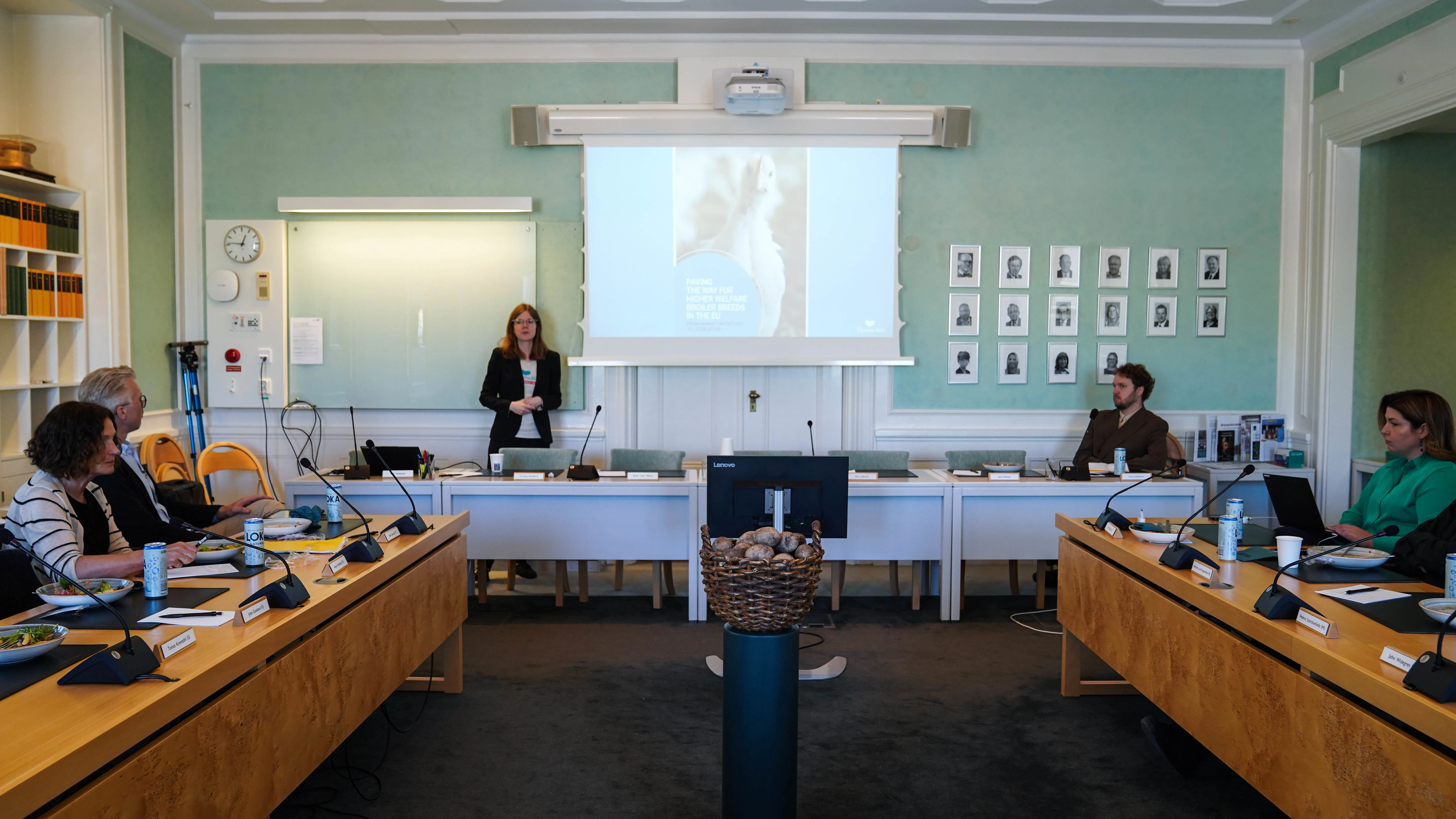
Parliamentary seminar on the chicken industry – What can Sweden learn from Denmark?
On Wednesday, Project 1882 organized a seminar in cooperation with the Swedish Parliamentary Animal Welfare Forum. The parliamentary seminar focused on the welfare of chickens and among the invited speakers were Carl Valentin, member of the Danish Parliament, and Professor Linda Keeling from SLU.
On May 22, Carl Valentin, Member of the Danish Parliament, visited a parliamentary seminar in Sweden to talk about the broad agreement on animal welfare reached this year between the Danish government and the other Danish parties. The agreement's 31 initiatives include a phase-out of frankenchickens in government procurement, and that Denmark will work towards a ban at EU level. Carl Valentin belongs to the Socialist People's Party (SF). Among other things, he is the spokesperson for animal welfare issues and has been the driving force behind the development of the policy on chickens that the Danish Parliament now supports. The parliamentary seminar was organized by Project 1882 together with the Parliamentary Animal Welfare Forum and was mainly attended by Swedish members of parliament.
– I am pleased to have been invited. It is an important issue, and my view is that the use of frankenchickens must stop. It is a completely substandard way of keeping animals, said Carl Valentin (SF), Member of the Danish Parliament.
The second speaker at the seminar was Linda Keeling, Professor of Animal Welfare at the Swedish University of Agricultural Sciences (SLU). She spoke about the work on scientific recommendations for chicken farming that has been developed by EFSA, the European Food Safety Authority.
During the seminar, Project 1882 outlined the measures they want to see and presented five policy priorities to improve the welfare of chickens. The Swedish Animal Welfare Act states that animals should have the right to their natural behavior, be treated well and protected from suffering and disease. But today's intensive farming of frankenchickens, which grow from 40 grams to two kilos in 35 days, has many problems. This has become clear, among other things, in a Project 1882 review of animal welfare controls and in Swedish media.
– It is important to learn and be inspired by countries that have dared to lead the way. We had good discussions during the seminar and hope that a majority will be formed in the Swedish Parliament to phase out the use of frankenchickens, says Sebastian Wiklund, Director of Public Affairs at Project 1882.
Five policy priorities
-
Ban the use and breeding of frankenchickens.
-
Act to phase out the breeding of frankenchickens in the EU and to speed up the revision of animal welfare legislation.
-
Set requirements for government procurement of chicken meat.
-
Ensure that the competent authority has sufficient resources to implement the Animal Welfare Act.
-
Promote the production of plant-based alternatives to chicken meat.
