As an EU citizen you can make your voice heard and demand a faster transition to animal-free methods! Sign the petition now →
Interview: Research on in-ovo sexing
In an interview with Project 1882, PhD student Simão Monteiro Belo dos Santos discusses research on in-ovo sexing that could put an end to the killing of male chicks in the egg industry.
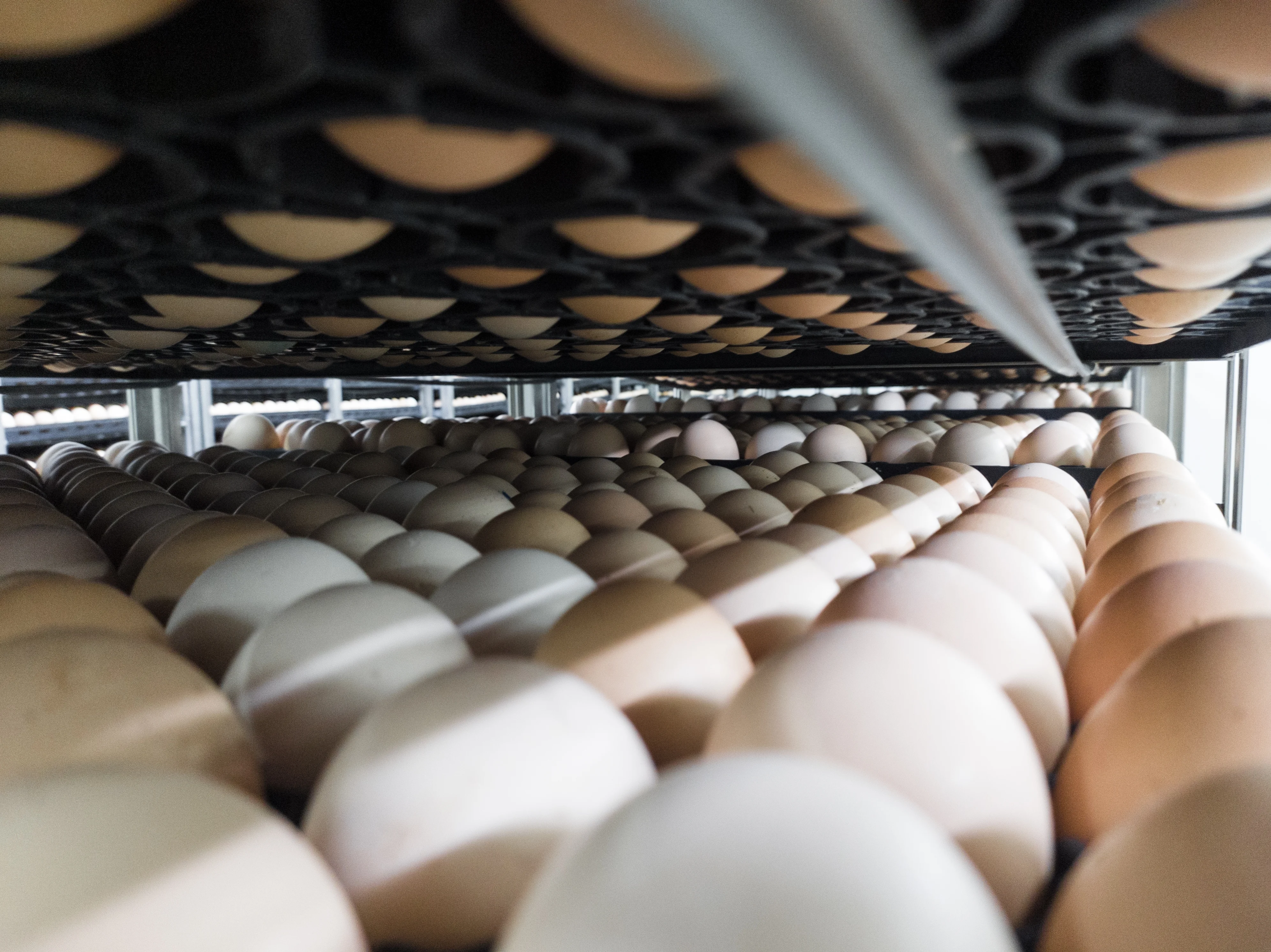
Simão Monteiro Belo dos Santos is approaching the end of his PhD at KU Leuven in Belgium. His research focuses on in-ovo sexing technology capable of identifying male eggs before hatching – a technique that could put an end to the culling of male chicks in egg industries.
Tell us about your PhD research.
- My PhD research is within the context of in-ovo sexing—the preferred choice for preventing male chick culling, meaning the culling of day-old male chicks in the laying-hen industry because they have no use for them in the industry. During my PhD, together with Matthias Corion and supported by our supervisors, we mapped scientific literature and patents on existing techniques, then selected and developed the ones we considered most promising. In my case, I focus on a microfluidic platform for detecting female-specific genes. These platforms use tiny channels to handle very small volumes of liquid, enabling fast and potentially scalable genetic analysis.
What problem do you think in‑ovo sexing is best suited to address, and what problems does it not solve?
- The obvious one is avoiding the culling of day-old male chicks—that’s why we do this research. But technologies can also enable production optimization, like better use of incubator space that could reduce energy costs and enable multi-parameter analysis (like fertility and health). What it doesn’t solve: there will be an increase in price, and some techniques produce chemical waste that affects sustainability. And the biggest ethical uncertainty is pain perception—there are different assessments about when embryos can perceive pain. There's a very big question around it, and it's quite important to solve it and to actually have concrete data, perhaps with some independent research and large validation sets.
Are there any common misunderstandings about in‑ovo sexing that you often encounter?
- A common one is: “Why don’t we just eat the males?” Then I explain these are two different industries—laying hens for egg production versus broilers for meat—and laying-hen breeds aren’t efficient for meat production. More broadly, people are often disconnected from how food production works, so you end up explaining basics like what broilers and laying hens, after which people also start understanding some of the challenges associated with current production systems.
You are seeking a postdoc position focused on developing organ-on-chip platforms and advanced in vitro models to reduce the use of animals in research –can you tell us more about that?
- Organ-on-a-chip platforms are microfluidic systems where you put cells (for example barrier cells or organoids) into channels and perfuse liquids to mimic organs on small platforms. Compared to standard 2D cell cultures, they can be more physiologically relevant because the body is dynamic—flows, perfusion, interactions. Compared to in vivo animal models, they can use human-relevant cells, even directly from patients, and we should avoid using animals as much as possible to avoid animal suffering.
Read more:
Read more about how Project 1882 works to help male chicks
Read more about how Project 1882 is mobilizing against animal testing
Help us save lives!
Project 1882 strives for a world where every animal life matters. By supporting our work, you help make our vision a reality.
