- European Commisison, “Slaughter and stunning”. Website: Slaughter & Stunning - Food Safety - European Commission. Last visited 2026-04-10
- Council Regulation (EC) No 1099/2009 of 24 September 2009 on the protection of animals at the time of killing
- Welfare, E. P. O. a. H. A., Nielsen, S. S., Alvarez, J., Bicout, D. J., Calistri, P., Depner, K., Drewe, J. A., Garin‐Bastuji, B., Rojas, J. L. G., Schmidt, C. G., Chueca, M. Á. M., Roberts, H. C., Sihvonen, L. H., Spoolder, H., Stahl, K., Calvo, A. V., Viltrop, A., Winckler, C., Candiani, D., . . . Michel, V. (2019). Killing for purposes other than slaughter: poultry. EFSA Journal, 17(11), e05850.
- The American Veterinary Medical Association (2013) AVMA Guidelines for the Euthanasia of Animals: 2013 Edition. s. 67.
- Klinikum rechts der Isar, Technische Universität München (2023) Projektzusammenfassung: Schmerzempfinden bei Hühnerembryonen.
- Petrik, M. T., & Petrik, J. J. (2026). Onset of nociception and pain perception in chicken embryos – a review. World S Poultry Science Journal, 1–10.
- Scientific Services of the German Parliament, Wissenschaftliche Dienste des Deutschen Bundestages (2017) Sachstand zum Schmerzempfinden von Hühnerembryonen - WD 8 - 3000 - 030/17.
- Malchow, J., & Schrader, L. (2021). Effects of an elevated platform on welfare aspects in male conventional broilers and Dual-Purpose chickens. Frontiers in Veterinary Science, 8, 660602.
- Rieke, L., Spindler, B., Zylka, I., Kemper, N., & Giersberg, M. F. (2021). Pecking behavior in conventional layer hybrids and Dual-Purpose hens throughout the laying period. Frontiers in Veterinary Science, 8, 660400.
Remind the Commission of Fur Free Europe's demands: a ban on fur farming and the trade in fur on the EU internal market! Send email today →

Animals in factory farms
Male chicks
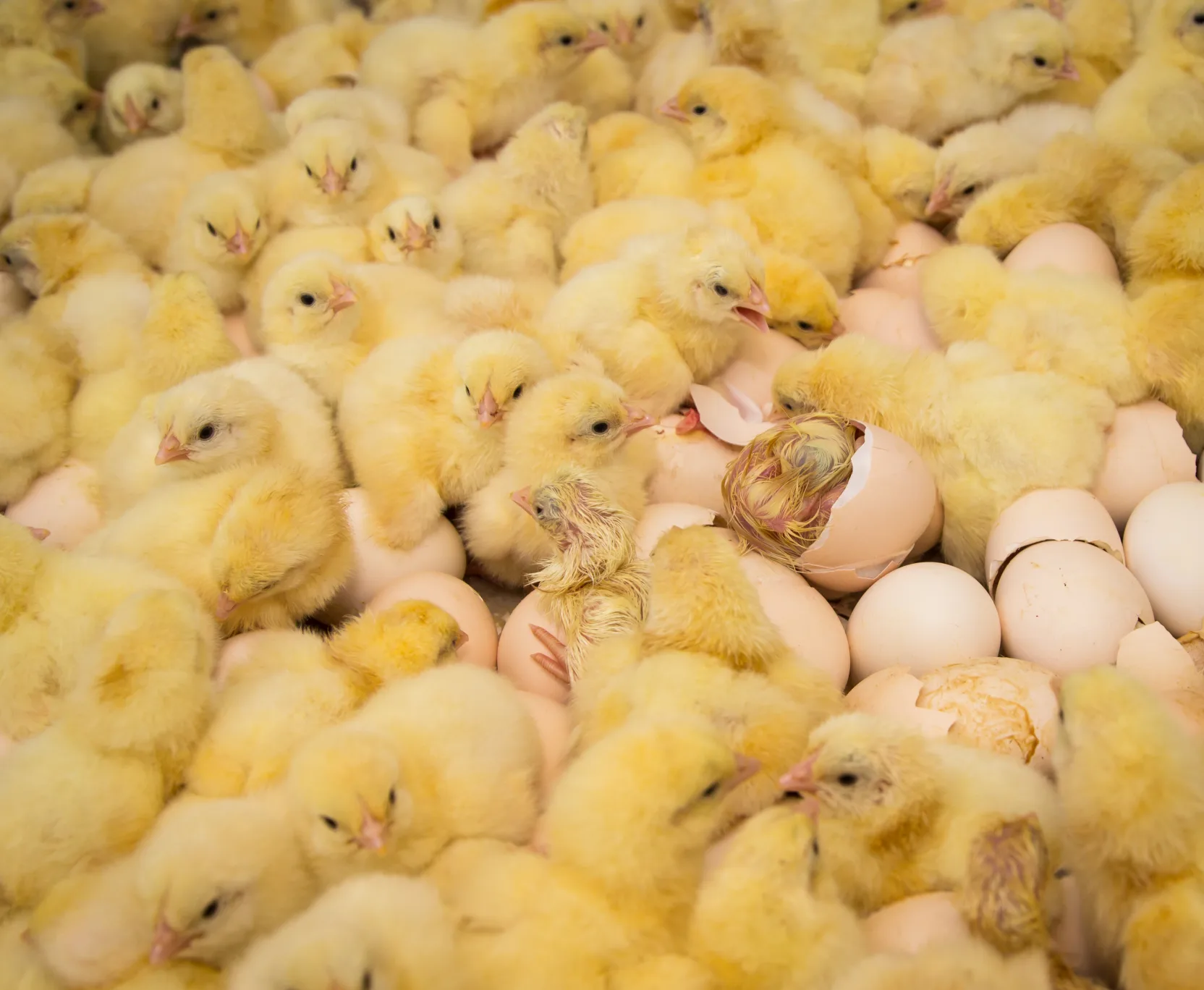
Around 330 million newly hatched male chicks are killed in the EU every year, simply because they are not considered economically viable for the egg industry. They are usually killed either by asphyxiation with carbon dioxide or by being ground up alive.
It doesn’t have to be this way. Project 1882 actively works to stop the mass killing of male chicks in the EU.
This is what Project 1882 is doing for male chicks:
- Informing the public about the animals' situation.
- Putting pressure on politicians and authorities to change laws that affect male chicks in the EU.
- Operating the inspirational website “Välj Vego” (Choose Veg), which aims to make it easier for more people to choose alternatives to eggs.
Content
On this page
Male chicks
The three biggest issues
Short lives
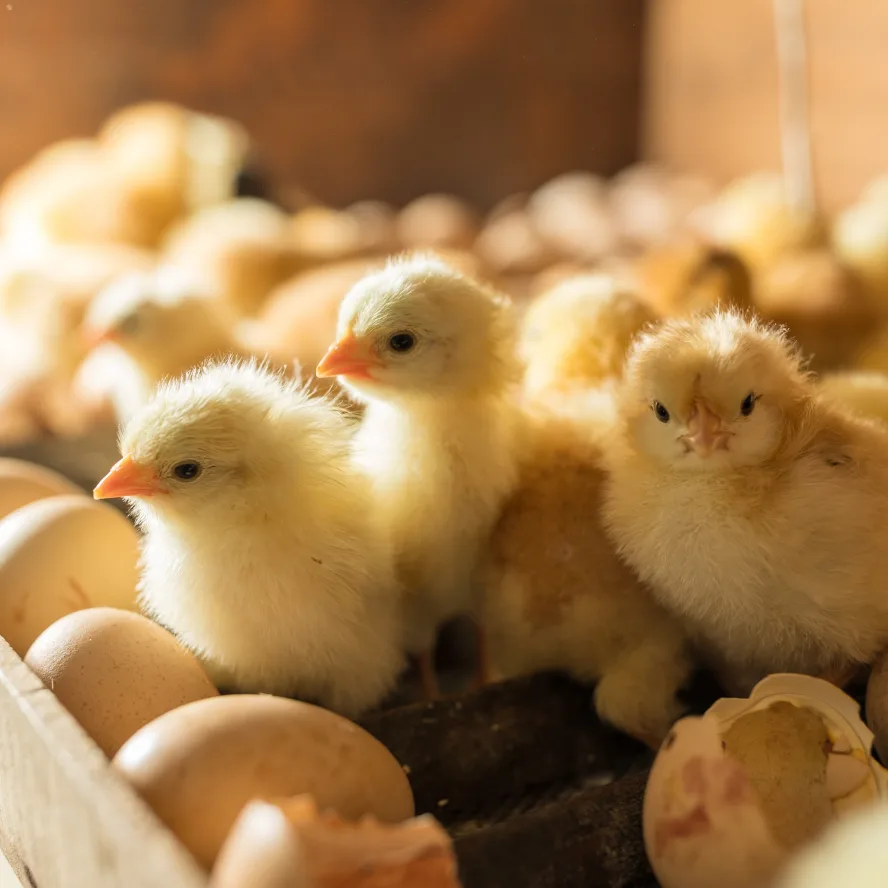
Male chicks are killed on their first day of life, simply because they are considered unprofitable for the egg industry. At least 900,000 newly hatched male chicks are killed every day in the EU.

Painful death
After just one day of life, male chicks are killed either by asphyxiation with carbon dioxide or by being ground up alive. These methods cause fear, pain and suffering in the chicks.

Not using alternative methods
There are options available that can put a stop to the mass killing of male chicks, such as in-ovo sexing and dual-purpose breeds, and these methods are already in use in countries including Germany, France and Norway.
Male chicks
Issues with the killing of male chicks
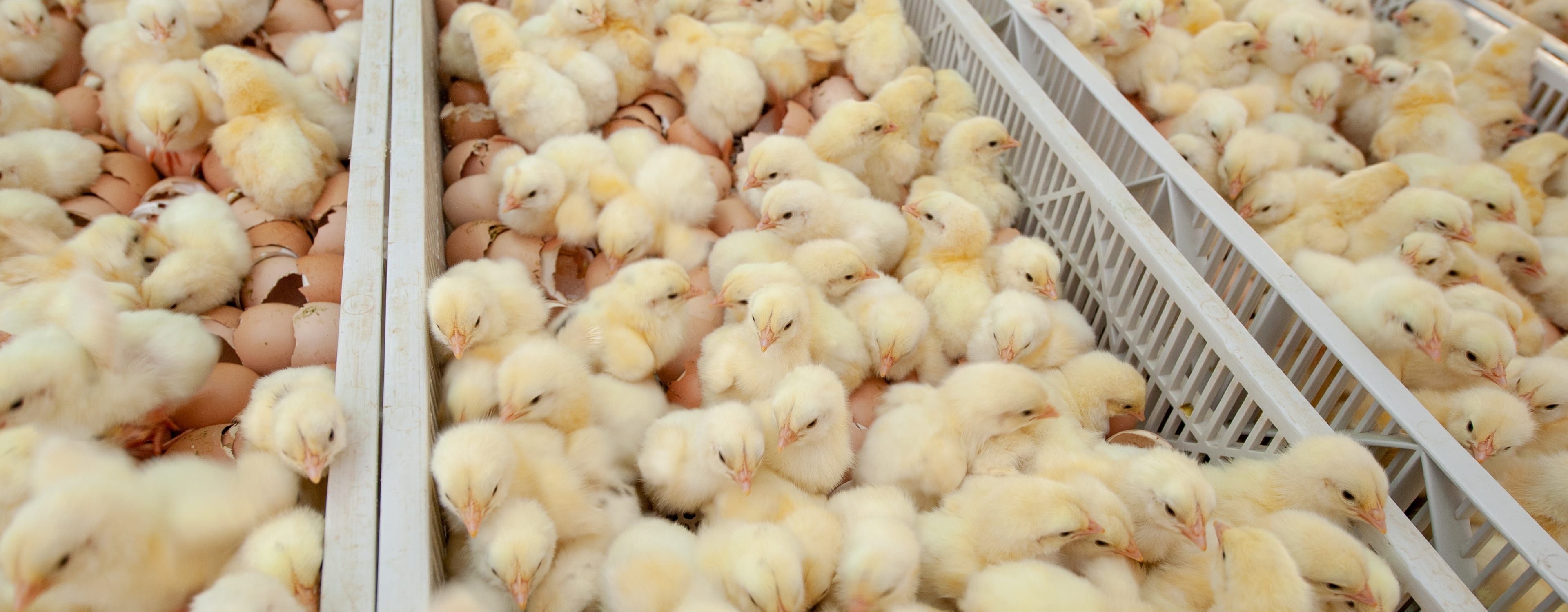
Around 330 million male chicks are killed every year, simply because they are not considered to have any economic value to the egg industry. They are killed either by gassing or by being ground up alive. Solutions to these problems exist, such as in-ovo sexing, and are already in use in other countries.
Short lives
Around half of all chicks that hatch from eggs are male. Within the EU, this amounts to approximately 330 million male chicks in the egg industry being hatched at hatcheries each year.1 The eggs are first placed in an incubator for 18 days, a machine that controls temperature and humidity, before being transferred to hatching machines where the eggs begin to hatch after about 3 days. Once enough eggs have hatched, the chicks are transported on a conveyor belt and sexed by people who examine their genitalia or wings.
The female chicks are transported to egg-laying factory farms, whilst the male chicks are killed on their first day of life. This means that at least 900,000 newly hatched male chicks lose their lives every day in the EU, simply because they are considered unprofitable for the egg industry. Male chicks of laying hybrids are not considered to grow fast enough or develop enough muscle for meat production and cannot lay eggs.
Painful death
EU law, regulated in 1099/2009 on the Protection of Animals at the Time of Killing, allows two killing methods for day-old chicks.2 Both methods are used, but there are no official numbers on the use of each method in EU Member State hatcheries. The chicks are killed either by asphyxiation with carbon dioxide, or by maceration (being shredded or ground up alive).
The European Food Safety Authority (EFSA) has reported on the risks and associated welfare consequences of the methods used to kill male chicks.3 EFSA notes, among other things, that the use of carbon dioxide to asphyxiate male chicks leads to unavoidable welfare consequences such as breathing difficulties, fear and pain. Maceration, which involves grinding up the male chicks alive, can also lead to fear and pain.

Not using alternative methods
The mass killing of male chicks is no longer an issue in certain EU Member States. Germany and France are examples of countries where the systematic mass killing of male chicks in egg-laying factory farms is banned, and technology that can sex the chicks whilst they are still in the egg has instead been promoted.
In-ovo sexing
In-ovo sexing is a technology that makes it possible to sort out male chicks before they have hatched. There are various methods available on the market, and several more are currently being developed. Technology for in-ovo sexing is already in use in hatcheries in countries including Norway, Germany, France, Italy, the USA and Brazil.
Male chicks suffer when they are killed on their first day of life, but the ability to feel and process pain has already developed while they are still in the egg. However, research is not unanimous on exactly when the chick embryo develops the ability to experience pain; various studies point to times around day 11,4 day 13,5 and day 16–17.6 Sorting of the eggs should therefore take place as early as possible to reduce the risk of suffering, preferably before day seven in the incubator.7
Dual-purpose breeds
However, in-ovo sexing does not solve the animal welfare and ethical issues associated with factory farming. Another alternative is therefore to transition the egg industry to so-called dual-purpose breeds. These are breeds in which the hens lay a relatively high number of eggs, whilst the roosters grow faster and develop more muscle than roosters from breeds bred for high egg production.
The use of dual-purpose breeds would address the killing of newly hatched male chicks and reduce suffering in the egg and meat industries, as dual-purpose breeds have been shown to have fewer animal welfare issues than laying hens and Frankenchicks bred for high production.8,9 The introduction of dual-purpose breeds must be carried out in connection with an increase in plant-based production and consumption, so as not to increase the number of animals in factory farms.
Support usDonate
Support our work for male chicks!
Project 1882 works for the animals that are the most exploited and suffer the worst. Thanks to your support, we can change the situation of male chicks in factory farms.